The Covenant of the Pit: Why Heavy Music's Faithful Keep Coming Back After Everything

Let's be honest about what the scene has put its own people through.
Venues that were home bases for entire regional communities — gone, turned into condos or parking structures or just sitting empty because the economics stopped working. Bands that turned out to harbor people who should've been removed years ago. Streaming platforms that treat heavy music like a rounding error. Ticket prices that have made the pit a luxury. Corporate festival lineups that take the aesthetics of the underground and launder them into a product safe enough for a sponsored stage.
The list of legitimate grievances is long and it keeps growing. If you've been paying attention, you've had plenty of reasons to walk away.
And yet.
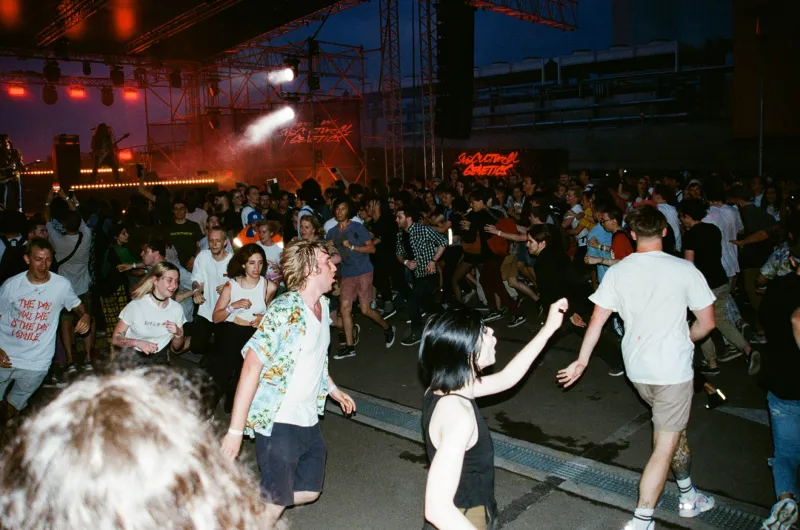
Every weekend, in VFW halls and DIY spaces and the surviving all-ages venues and the bars that still book local hardcore bills, people are showing up. Not reluctantly. Not out of habit. With the kind of commitment that looks, from the outside, like it makes no rational sense whatsoever.
So what is that? What keeps the faithful in the room?
It Was Never About the Industry
The first thing to understand is that the loyalty heavy music fans maintain has almost nothing to do with the institutional apparatus surrounding the genre. It was never about the labels, the booking agencies, the festival promoters, or the streaming platforms. Those were always just infrastructure — sometimes useful, often hostile, never the point.
The point was always the music itself and the experience of being in a room where it was happening. That's a distinction that sounds obvious until you realize how thoroughly the mainstream music world has confused the two. When a pop artist's label collapses or a streaming deal goes sideways, it registers as a genuine crisis because the infrastructure is the product. The packaging is the thing.
In heavy music, the infrastructure has always been secondary to the experience. The pit doesn't care who distributed the record. The circle pit doesn't stop because the label folded. The moment when a room full of people who've never met each other are all feeling the same thing at the same decibel level — that doesn't require any institutional support to happen.
Strip everything else away and that moment is still there. That's what people are coming back for.
The Unspoken Agreement
There's a covenant in heavy music that nobody ever writes down but everybody who's been in it long enough understands. It goes something like this: the music will not lie to you about what it is, and in return, you will show up for it honestly.
Heavy music — real heavy music, the kind that lives in the underground and only reluctantly surfaces into mainstream visibility — does not promise you a good time. It does not promise resolution or comfort or the reassurance that everything is going to be okay. It promises intensity. It promises that whatever you bring into that room with you — the grief, the rage, the anxiety, the loneliness — will be met with something that matches it.
For a lot of people, that's the only honest transaction available to them. Everything else in American culture right now is selling optimism, or at least the performance of it. Heavy music is the one space where you can walk in carrying something genuinely dark and not be asked to pretend otherwise.
That's not a small thing. For a lot of people, it's the whole thing.
The Scene Has Always Been Disappointing and We've Always Known
Here's the uncomfortable truth that heavy music fans have been sitting with for decades: the scene has never been as pure as the mythology suggests. The underground has always had bad actors. The DIY community has always had its internal hierarchies and gatekeeping and the particular cruelties that small, tight-knit communities generate when they turn inward.
What's changed isn't the existence of those problems — it's the visibility. Social media made it impossible to maintain the comfortable fiction that the pit was a utopia. The accountability conversations that have happened in heavy music over the last decade, however messy and incomplete, were necessary precisely because the community was forced to confront things it had been quietly tolerating for years.
And here's what's remarkable: the community mostly stayed. Not unchanged — it's been genuinely reckoned with in a lot of places, at least partially. But the response to the scene's failures wasn't mass abandonment. It was, for a lot of people, a kind of stubborn insistence on making it better while staying inside it.
That's not blind loyalty. That's the behavior of people who understand that the alternative — ceding the space entirely — helps nobody who needs it.
What Mainstream Culture Will Never Get
The mainstream keeps trying to understand heavy music fandom through the lens of consumer behavior, and it keeps failing because that framework can't account for what's actually happening.
Heavy music fans aren't consumers of a product. They're participants in a practice. The distinction matters enormously. A consumer can be lost when the product disappoints or the brand behaves badly. A participant in a practice has a relationship with the thing itself that doesn't route through the institutional apparatus at all.
When you've been in a pit and experienced that specific loss of self — the way your individual anxiety dissolves into collective physical intensity, the way the music at that volume stops being something you're listening to and becomes something you're inside — you understand something about the human capacity for communal experience that is genuinely difficult to access anywhere else in American life.
That experience doesn't belong to the label that released the record. It doesn't belong to the promoter who booked the show. It belongs to the people in the room, and it persists in them long after the venue closes and the band breaks up and the record goes out of print.
Why They Keep Coming Back
People keep showing up to heavy music not despite its problems but in full knowledge of them, because the thing at the center of it — the music, the community, the covenant — is worth defending.
It's worth defending from the corporate co-optation that wants to turn it into a lifestyle brand. It's worth defending from the bad actors who've used the community's insularity as cover. It's worth defending from the economic forces that are closing the venues and pricing out the kids who need it most.
The mainstream will never understand this kind of loyalty because it doesn't have anything worth being loyal to in the same way. Nothing in the commercial music landscape offers what heavy music offers: a space where you can be genuinely, unapologetically broken, and find a room full of people who are broken in exactly the same direction.
The pit doesn't care about your politics, your aesthetics, your streaming numbers, or your career trajectory. It cares whether you showed up.
And the faithful always show up.